How to Make a Study Schedule From Your Syllabus
A study schedule that lasts past week two starts from the syllabus, not a blank calendar. How to build one for a full course load, week by week.
By Hunter Forbes
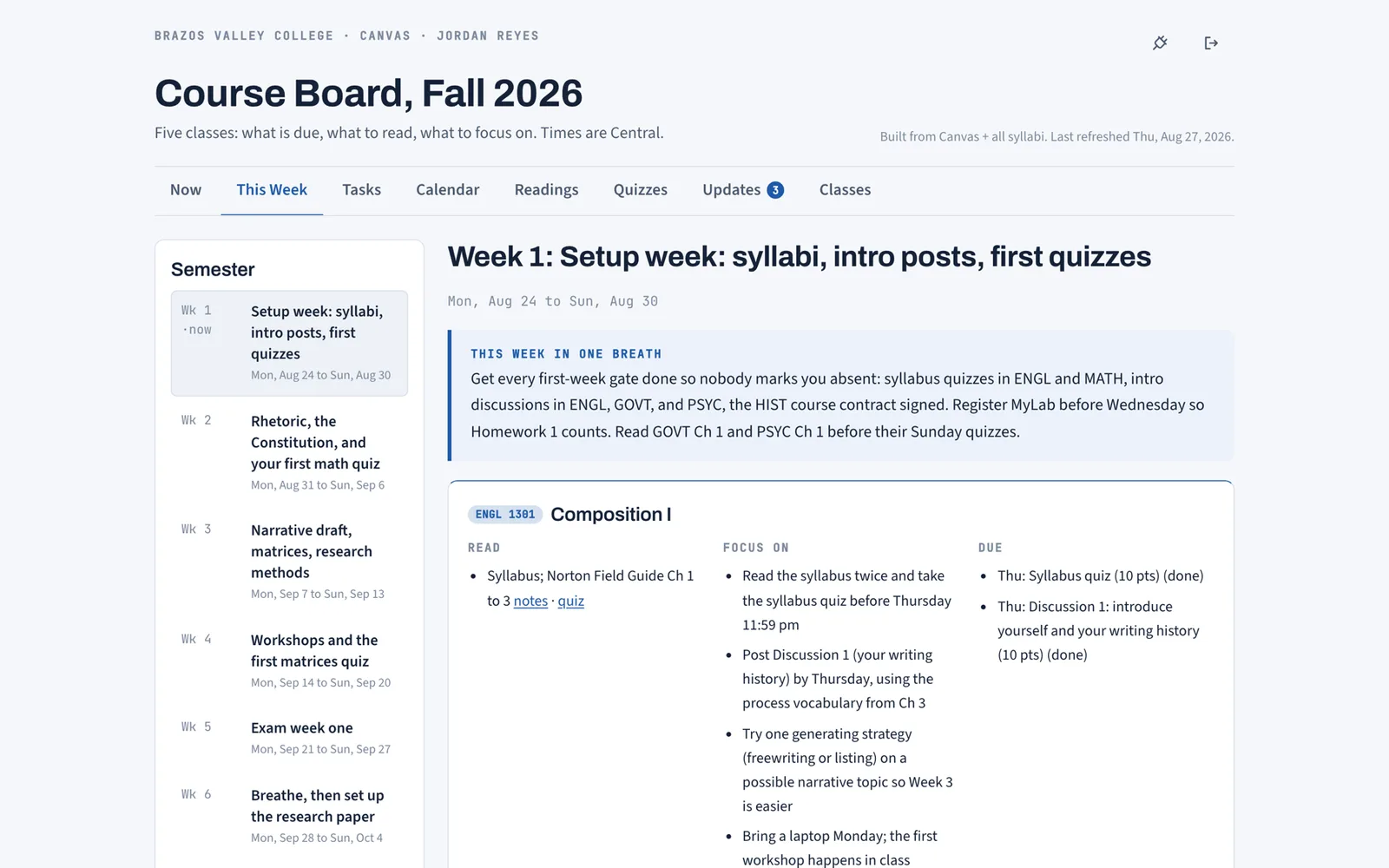
To make a study schedule that you will still be using in November, start from what is already fixed: the exam dates and reading list in each syllabus, and the due dates in Canvas. Put those on a sixteen-week grid first. Then, and only then, decide what to study each week. A schedule built the other way around (block out hours, then hope the work fits) breaks the first time an instructor moves a deadline.
This is the method, step by step, for a normal college load of four to six classes. It takes about an hour the first time.
Step 1: collect the fixed dates from every syllabus
Open each syllabus PDF and write down, per course:
- Every exam, test, and quiz that happens in class or in a testing center, with the date.
- The final exam date and time (often on a separate university schedule, but the syllabus usually says).
- Big deliverables: papers, projects, presentations, lab practicals.
- The reading assigned per week, if the syllabus has a week-by-week table. Most do.
- Grade weights. If exams are 60 percent of the grade and homework is 10 percent, that changes what you study.
- The rules that can cost you the course: attendance limits, late policy, the drop date.
Do not skip the small stuff. Reading quizzes that are "5 minutes at the start of class, no makeups" are the ones that quietly eat a letter grade.
Step 2: pull the Canvas due dates
Canvas has the homework sets, discussion posts, online quizzes, and anything else the instructor collects online. Open each course's Assignments page and note the due dates, or use the Canvas calendar for a month view. If your school is on Canvas and you would rather not copy by hand, a Canvas-synced planner pulls every assignment with a due date in one step. Either way, you now have two lists per course: what the syllabus says and what Canvas says. They will not match, and that is normal. The syllabus has the exams; Canvas has the homework.
Step 3: lay it all on a sixteen-week grid
Most US semesters are fifteen or sixteen weeks plus finals. Make a grid: one row per week, one column per course. Put the fixed dates in the cells. Now you can see the shape of the term:
- The weeks where two exams land together.
- The stretch after midterms where nothing is due and everyone coasts, right before a paper is due.
- The last three weeks, where every course piles up.
This grid is the study schedule. Everything after this is just filling in what to do during each week.
Step 4: give every week one focus
For each week, write one sentence that says what matters most. Not a list, one sentence. Examples from a real five-course demo term:
- Week 1: get every first-week gate done so nobody marks you absent: syllabus quizzes, intro discussions, the course contract.
- Week 5: exam week one. HIST and GOVT both test; PSYC reading can slip to Sunday.
- Week 9: the research paper draft is the only thing that matters; keep the homework sets on time but do not polish them.
The one-sentence focus is what you read on Monday morning. It stops you from spending Tuesday on the easiest assignment instead of the exam that is Thursday.
Step 5: for each course, each week, decide read, focus, due
Under the focus sentence, make three short lists per course:
- Read: the chapters or pages assigned this week, from the syllabus.
- Focus on: the two or three things to actually understand, in plain words. "The three branches and how each checks the others," not "Chapter 2."
- Due: what has a deadline this week, with the day.
This is the level where a schedule becomes useful. "Read Ch 4" is a task. "Understand why the Articles of Confederation failed, because that is the essay prompt on the exam" is a plan.
Step 6: put study blocks on your real calendar
Now, finally, hours. Look at your class times, work shifts, and commute. Find the recurring open blocks. Assign the week's reading to the early blocks and the practice (quizzes, problem sets) to the later ones, because reading before practicing is what makes the practice stick. Keep the blocks short and named: "Tue 2 to 3:30, GOVT Ch 2 plus quiz." A block called "study" gets skipped.
Two rules that keep this honest:
- Never schedule more than you did last week plus a little. If you studied six hours last week, do not plan twenty.
- Leave Sunday afternoon empty on purpose. That is the catch-up block, and something will need it.
Step 7: check yourself before the exam, not after
The cheapest study tool is a practice quiz taken before the exam, when a wrong answer still costs nothing. For every reading on the schedule, find or make eight questions and take them the day after you read. If you cannot find any, write them from the chapter headings. On Coursemap every assigned reading already has notes, terms, and an 8 question self-check, so the "find or make" step is done.
Step 8: update the schedule every Sunday
Ten minutes. Open each course in Canvas, compare it to the grid, move anything that moved. Read next week's focus sentence and adjust it if an exam got pushed. A schedule that is updated weekly survives the term. One that is set once in August does not.
The whole thing, in one weekly routine
- Sunday: ten-minute reconcile. Read next week's focus.
- Monday: read the This Week view. Know the one thing that matters.
- Each study block: read first, then quiz yourself, then check the item off.
- Thursday: look at the next seven days. Anything due Monday gets started.
How Coursemap builds this for you
Coursemap does steps 1 through 5 from your syllabi and your Canvas assignments. You paste a Canvas token, upload each syllabus PDF, and the board builds a sixteen-week plan: each week gets a title, a one-breath focus, and per course the Read, Focus on, and Due lists. Every reading links to its notes and quiz. The Now tab shows the next seven days; the This Week tab is the schedule above, on screen. Steps 6 and 8 are still yours, because only you know your shifts and your Sundays.
Three mistakes that break study schedules
Planning hours before planning content. "Study 2 to 4 every day" fails because 2 pm arrives and you do not know what to open. Decide the chapter and the task first; the hour is the last thing you assign.
Treating every course the same. A course where exams are 70 percent of the grade and a course where weekly homework is 50 percent need different weeks. Read the grade weights in each syllabus (the schedule is built from them, not from how much you like the subject).
Never revising. Instructors move deadlines, cancel a class, push an exam a week. A schedule that is not touched after August is fiction by October. The ten-minute Sunday reconcile is the whole method; everything else is layout.
A worked week from the demo term
Week 5 in the demo semester (five courses, fifteen hours) looks like this on the board. The focus sentence: exam week one; HIST and GOVT both test, PSYC reading can slip to Sunday. Under it, HIST reads chapters 5 and 6 with a focus on the causes of the Revolution, and the exam is Thursday in class. GOVT has no new reading; the focus is the Federalist papers already assigned, and the exam is Friday online. MATH keeps its normal homework set, due Sunday. ENGL has a draft due Monday of week 6, so the focus is an outline by Friday. PSYC's chapter 4 reading is listed, and the note says Sunday is fine.
That is a schedule: two exams get the week, the draft gets a head start, one reading is deliberately deferred, and nothing is forgotten because it was all on the grid from the syllabus in week one.